
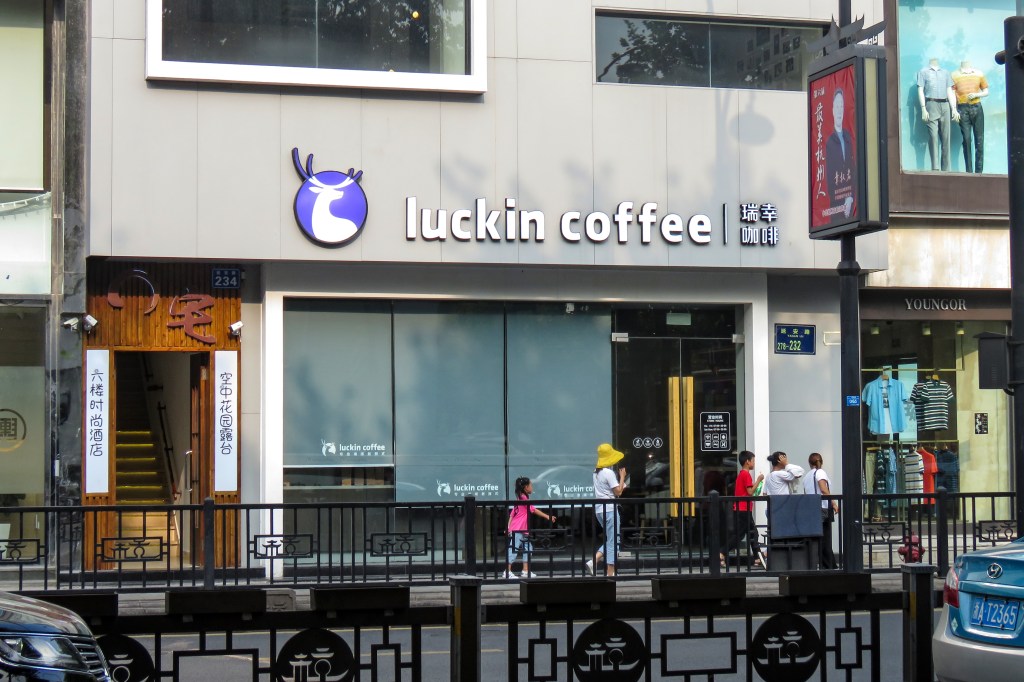
The story was published on 1611, a financial magazine in Taipei in 2022“Who doesn’t love that little blue cup?” This slogan was once ubiquitous in advertisements across the Chinese market. Touting itself as the “Chinese Starbucks,” the coffee chain Luckin Coffee was founded in 2017. Within two years, it was listed on the Nasdaq Exchange in the U.S., breaking the fastest IPO record of Chinese companies in the US market.
Though the market sang and danced in celebration of the brand as “China’s coffee dream come true,” an 89-page short-selling report published on January 31, 2020, sounded the death knell for the company.
The report compiled by Muddy Waters Research, known for short-selling stocks of Chinese companies, debunked lies perpetrated by Luckin Coffee and exposed numerous deceptions, including accounting fraud and inflated revenue numbers. Initially, Luckin Coffee hoped to cover up the scandal, but eventually came forward to the U.S. Securities and Exchange Commission, and confessed to falsifying sales figures of up to 2.2 billion RMB (approximately USD$345 million). The news shattered any remaining hopes investors had as the Luckin Coffee stock price fused six times and plummeted 85% in value. On June 29 of the same year, Luckin Coffee was hastily delisted from Nasdaq.
The “coffee dream” that seemingly came true was actually an illusionary bubble forged by capital gameplaying. So, how did Luckin Coffee end up in such a state?
The Boom of the Little Blue Cup
Luckin Coffee started the trend of “take-out coffee,” offering online transactions for orders and payments. Users could place an order, select the coffee flavor, complete payment, and choose delivery or self-pickup through its app. Most shops offered seating for only two or three people. Some consisted of only a counter for fast pick-up of orders.
The company also strived to establish a memorable brand image by creating a navy blue cup featuring a simple yet hip style with an antler logo. The goal was to make it fashionable for customers to “show” the Luckin coffee cups on social media. The company also hired celebrities, such as Tang Wei, the female lead in Ang Lee’s epic romance “Lust, Caution,” to endorse the brand as stylish and trendy.
The business boomed right from the beginning, selling 5 million cups within six months and an explosive 85 million cups by year-end. When the company was first established, founder Jenny Qian vowed to become the “Starbucks of China.” As of the end of 2019, Luckin Coffee had opened 4,507 branches, exceeding Starbucks’ 4,300 store locations after about 20 years in business.
From the business analysis perspective, many red flags are hidden beneath numbers that tout a superb performance.
Red Flag #1: Persistent Negative Cash Flow
Even though the expansion speed was very impressive, a simple review of the financial report (see the red box in the table below) would reveal that Luckin Coffee was not equipped to earn cash income. In fact, the operating cash flow in 2018 and 2019 was -1.03 billion RMB and -1.12 billion RMB, respectively.
What did the numbers represent? The data showed that as long as the company was open for business, it would burn nearly 3 million RMB (approximately USD$470 thousand) per day. Where did the money come from when the company burned cash at such a high daily rate? The answer may be found in the financial report (see the yellow box in the table below).
Raising funds for the cash flow shows how much money the company could pitch in the capital market. The table shows that Luckin Coffee raised 2.55 billion RMB (approximately USD$400 million) in 2018, and the number shot up to 5.49 billion RMB (about USD$861 million) in 2019, which meant that the company raised several billion RMB in cash to pay for business expenses in those two years.
The message revealed by the financial report may indicate that the company was not yet equipped with earning power, and daily expenses, such as rent, wage, utilities, and more, required external capital support. Therefore, once capital stops flooding in while the market loses confidence in a company, it could go out of business any day.
Some companies report only good news and hide the bad news to boost their brand image. Thus, the executive management may take a gamble and falsify financial reports when faced with complex challenges.

Red Flag #2: Strategic Losses
The netizens nicknamed Luckin Coffee “The Uncrowned King of the Money-Burning” on the Internet. One cup of Luckin coffee is roughly 21 to 27 RMB, about the exact pricing as Starbucks. However, the company frequently offered coffee for free or discount coupons of 82% or 62% off. As a result, the average cup of Luckin Coffee was only about 9 RMB, about one-third of the price on the menu.
Can such a strategy help the company make money? Of course not.
The promotional and discount craze cultivated an unyielding attitude among customers regarding the price of Luckin coffee. Consumers would only buy the coffee with a promotional discount, becoming a vicious cycle. To maintain the basic sales figures, the company had to keep giving out discounts.
Once during an interview, founder Jenny Qian stated: “Luckin Coffee can still be profitable without making money with coffee. We may even lose money to attract users. We can make money by retaining customers with other products and increasing the frequency of purchases and transaction price per customer to increase our income.” They referred to the “strategic losses” as expenses necessary to gain market share and popularity.
But what exactly are “strategic losses,” and how long should they last? How does the company intend to increase the price per customer transaction? What are some obvious risks that would occur before losses turn into profits?
Suppose the answers to these questions are not readily available. In that case, it is a sign that the company does not have any clear operational strategies, and the results are difficult to predict. Such companies do not make good investment targets. The father of securities analysis, Benjamin Graham, once said that a major principle of investment is to avoid principal losses. Warren Buffett also said that there are only two principles of investment: “Rule No. 1: Never lose money. Rule No. 2: Never forget rule No. 1”.
When there are tens of millions of companies to invest in the market, why would anyone choose a company with no clue about what it is doing?
The Thinking Behind Good-Looking Numbers
One of the reasons why Luckin Coffee captured the attention of the capital market was its rapid pace of store openings. The table below shows that the number of branch locations was 290 in Q1 of 2018, which grew twelvefold to 3,680 branch locations in Q3 of the following year.

Even though the numbers looked great in new shop openings, a closer examination would reveal something incongruent. Every quarter, Luckin Coffee would open hundreds of new shops, and the average number of customers remained relatively stable. However, the average sales volume increased substantially starting in Q2 of 2019. This would mean that when Luckin Coffee continued to open new shops, the number of customers remained the same, but every customer bought much more items.
This number raised the eyebrows of the Muddy Waters Research company. They hired investigators to make surveillance recordings, which showed inconsistencies between the actual amount purchased by customers vs. the numbers in the financial reports, thus exposing the company’s fraudulent activities.
When the numbers appear suspicious, investors may confirm the figures by performing some simple verification.
Previously, when American Express ran into trouble with its operations, Buffett did not worry too much about the plummeting stock price. Instead, he visited steakhouses and supermarkets to observe the habits of consumers. Buffett found that the problem wasn’t as severe as reported because everyone was still using American Express products. Therefore, Buffett decided to increase his holdings in the company. And it turned out that the result was excellent.
A simple field investigation and social observation allow investors to better understand the actual situation, which helps them avoid landmines and discover even more promising opportunities.




 Amber Tai
Leave a comment